
Anesthesiology | Prof. Feng Yi’s Latest Research Published in Prestigious BJA: Chinese Clinical Guidelines for Total Intravenous Anaesthesia
麻醉科冯艺执笔指南在麻醉学英文权威期刊刊登
2026-03-13
Recently, the “Chinese clinical practice guidelines for total intravenous anaesthesia: a systematic review and expert consensus-based recommendations” written by the team led by Professor Feng Yi from the Anesthesiology Department of Peking University People's Hospital was published in British Journal of Anaesthesia. This is the first clinical practice guideline in the field of anesthesiology in China to be published in an authoritative journal.
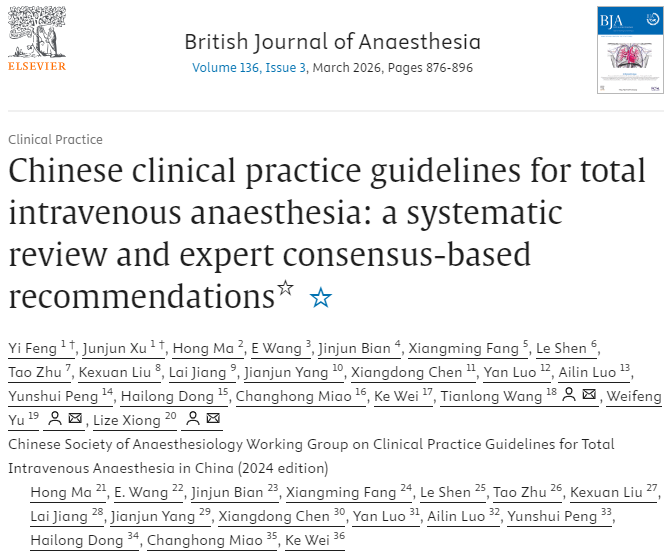
This guideline is strictly formulated in accordance with international standards. It systematically summarizes the clinical research and practical experience of China in the field of total intravenous anesthesia, providing scientific and standardized clinical guidance for anesthesiologists worldwide, especially those in developing countries.
The guideline addresses 12 core clinical questions in TIVA, with 22 formal recommendations graded according to levels of evidence and strength of recommendation. Key topics covered include: indications, contraindications and clinical advantages of TIVA; application of anaesthesia depth monitoring during implementation; pharmacological profiles of available intravenous anaesthetic agents; agent selection and administration protocols for both target-controlled infusion (TCI) and non-TCI regimens; and special considerations for TIVA use in vulnerable patient populations. The process of formulating this guideline is scientifically rigorous, aiming to systematically address key clinical controversies and providing authoritative and practical standardized guidance for the standardized application of TIVA in China.
Beyond providing authoritative guidance for clinical practice in China, the guideline’s publication delivers a robust, evidence-based Chinese framework for the global standardization of TIVA. The guideline introduces new sedative-hypnotic drugs such as ciprofol and remimazolam, providing more options for the implementation of TIVA. Particularly, these drugs demonstrate significant advantages in reducing hemodynamic complications.
The guideline also identifies two priority areas for future research: first, the development of pharmacokinetic (PK) and pharmacodynamic (PD) models and TCI regimens for newer agents including ciprofol and remimazolam, to enable precise dosing in special patient populations; and second, large-scale, multicentre clinical trials to systematically evaluate the efficacy and safety of TIVA across different surgical procedures and patient groups, with a focus on resolving ongoing clinical controversies around its impact on postoperative delirium and long-term oncological outcomes in cancer patients.
Paper link:https://pubmed.ncbi.nlm.nih.gov/41238462/
