
Rheumatology and Immunology | P2X7R Identified as a Potential Therapeutic Target for Refractory Rheumatoid Arthritis
2026-07-03
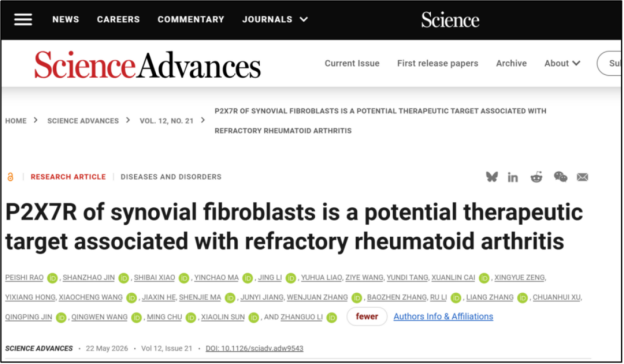
A recent study published in Science Advances identified the P2X7 receptor (P2X7R) as a promising therapeutic target for refractory rheumatoid arthritis (RA), offering a potential new treatment strategy for patients with limited response to current therapies. The research was led by Professor Li Zhanguoand Dr. Sun Xiaolin from Peking University People’s Hospital (PKUPH), in collaboration with investigators from Peking University and Peking University Shenzhen Hospital.
Despite major advances in targeted therapies, a subset of patients with RA remains inadequately controlled after multiple treatment regimens, with persistent synovial inflammation, progressive joint destruction, and declining physical function. Developing new treatment strategies for these patients remains a major unmet clinical need.
Using clinical cohorts and single-cell transcriptomic analyses, the investigators found that P2X7R was markedly upregulated in synovial fibroblasts from patients with difficult-to-treat RA, with expression levels three to five times higher than those observed in osteoarthritis controls. Elevated P2X7R expression was strongly associated with synovitis severity, higher disease activity scores, and the molecular subtype with high risk of resistance to multiple therapies.
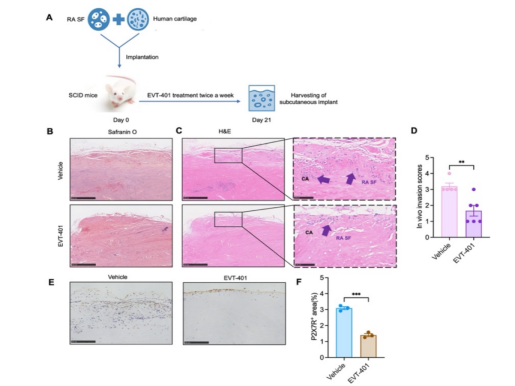
The study showed that P2X7R inhibition promoted apoptosis and induced cell-cycle arrest in synovial fibroblasts, reduced the production of proinflammatory and joint-destructive mediators, and mitigated their aggressive pathogenic behavior. These findings suggest that targeting P2X7R may help address not only persistent inflammation but also the synovial hyperplasia and structural joint damage that drive long-term disability in RA.
The team further evaluated EVT-401, a highly selective small-molecule P2X7R inhibitor, in a nonhuman primate model of autoimmune arthritis. EVT-401 markedly reduced synovial inflammation and arthritis severity while demonstrating a favorable safety profile.
Based on these findings, the Department of Rheumatology and Immunology at PKUPH has launched a nationwide multicenter Phase II clinical trial of EVT-401 in patients with moderate-to-severe active RA who have shown an inadequate response to methotrexate. The study provides a translational framework spanning target discovery, mechanistic validation, and early clinical development, offering a promising new therapeutic strategy for refractory RA.
Paper link: https://pubmed.ncbi.nlm.nih.gov/42172343/
