
Hematology | Donor Age May Outweigh Full HLA Matching in stem cell Transplantation for Severe Aplastic Anemia 供者“年轻”比“配型全合”更重要?黄晓军院士团队最新研究为再障移植供者选择提供关键证据
2026-04-17
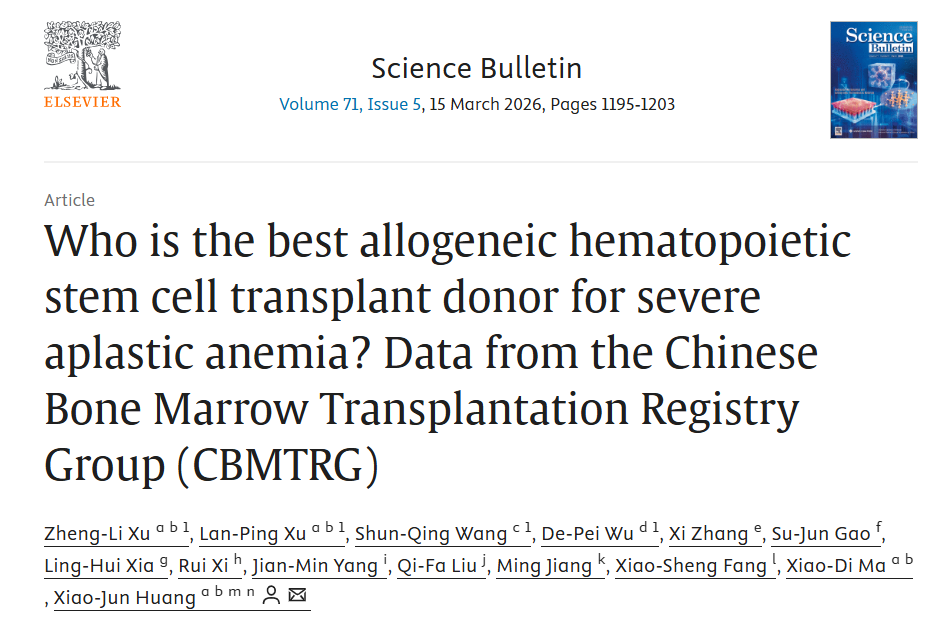
Results from a large multi-center study led by the research team of Professor Huang Xiaojun, Academician of the Chinese Academy of Engineering, Peking University People’s Hospital (PKUPH) and published in Science Bulletin suggest that donor age may be a more important predictor of outcomes than full HLA matching in severe aplastic anemia (SAA).
Allogeneic hematopoietic stem cell transplantation (allo-HSCT) is a curative treatment for SAA. Traditionally, fully matched sibling donors have been preferred whenever available. However, new evidence suggests that this long-held belief may need to be looked at again.
The study included 795 patients from 11 centers across China, with long-term follow-up. Overall outcomes were favorable, with a 7-year overall survival rate of 85.2%. A key finding was that donor age ≥50 years was associated with significantly worse survival and higher risk of treatment failure, with risks increasing by more than twofold.
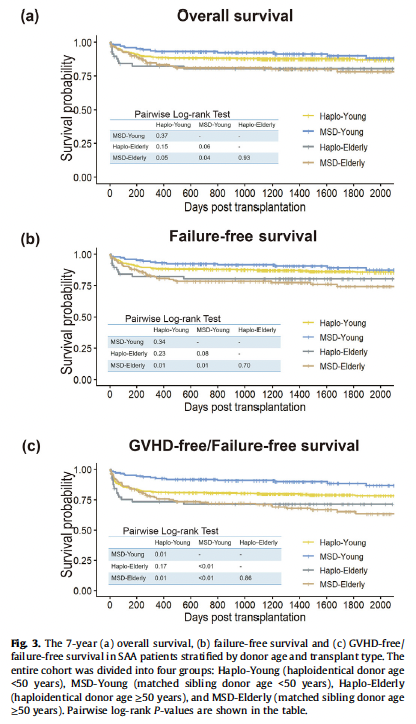
Notably, when donor age and donor type were analyzed together, younger haploidentical donors (<50 years) performed as well as, or even better than older matched sibling donors. In contrast, older matched sibling donors showed inferior failure-free survival. In some settings, younger haploidentical donors were associated with better outcomes than older fully matched donors.
These findings suggest that donor selection in SAA should move beyond HLA matching alone. Donor age, along with other clinical factors, may play a critical role in optimizing transplant outcomes. The study provides practical evidence to support more individualized donor selection strategy that emphasizes donor age over genetic compatibility.
Paper link: https://www.sciencedirect.com/science/article/pii/S2095927326000824?via%3Dihub=
